Anthony Kelly : Floating Point . Future Memories

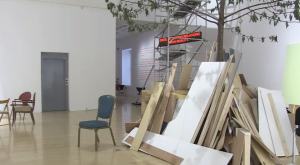
Anthony Kelly is a Dublin-based artist whose practice involves sonic and visual approaches to art-making. This includes painting, drawing, field recording, sculpture, sound installation, film/video, and improvised sound performance. Although diverse in construction, his work chiefly concentrates on the shifting and fragmentary nature of sensory experience. To explore this he uses the discarded or overlooked aspects of the world around him which he enlarges and amplifies to create his work.
Floating Point . Future Memories, his new exhibition at the Sirius Arts Centre further explores some of the ongoing themes inherent in his work while opening them out into new and varied directions. The exhibition will include the artist in conversation and an improvised sound performance by Kelly and invited guests.

November 06 – 26, 2016
Sirius Arts Centre, Cobh

Bernadette Kiely : A SECOND WORLD – any given day

A SECOND WORLD – any given day is a new body of work by Bernadette Kiely featuring large scale charcoal drawing, painting on canvas and moving image.

Bernadette’s recent work, continuing on her theme of the passage of time and the transient, fragile nature of the physical world, evident in her work to date – shifting landscapes cloaked in fog and mist, the burning of fields, flooding on the river Nore, plant life and the sea – references memories of her parents, the life they lived and the life that has died with them.

The title A SECOND WORLD – any given day suggests other worlds, the unknown world of the dead, the shadow world, where objects are visible, yet don’t exist in reality, the memory of things and people which exist in the memory but not in the real world, the psychological impossibility of recapturing people and things that have passed out of our living world.

Also including reference to the world of art making and thinking, she implies the difficulty of seeing reality as it apparently exists in the real world. The imagery she depicts is shrouded in mist and shadow and suggests memory, distance, desire and the melancholy inherent in the longing for people and things that have faded into the realm of the past.

Referencing her own photography and drawings, her work also draws on existing imagery of ancient and historical Irish architecture, archaeological and topographical drawings, plant life, the geography and anatomy of landscape and religious architecture.

3 November 2016 – 7 January 2017, Solstice Arts Centre, Navan

Miranda Driscoll : Here

For this exhibition Roseanne Lynch was invited to make work in response to the West Gallery of Sirius Arts Centre, which was formerly the Coffee Room of the Royal Cork Yacht Club. Through her photographic practice Lynch considers the connections and slippages between her subject matter and how it is re-presented. The photograph as object, the materiality of that object and of the subject depicted are among her areas of exploration.
The visitor is invited to spend time in the room; to consider its former histories, its architecture and how light flows through the space.

Roseanne Lynch exhibits nationally and internationally and is represented by Nag gallery, Dublin. She is a lecturer at CIT/Crawford College of Art and Design and CCAE and lives and works in Cork.

November 06 – 26, 2016
Sirius Arts Centre, Cobh

Stephen Brandes : Parc du Souvenir

Talbot Rice Gallery, Edinburgh
29 October – 17 December 2016

Parc du Souvenir comprises a new body of work by this Cork based artist that attempts to give form to both an interrelated and seemingly incongruous nebula of ideas and interests: from modern European history, Enlightenment philosophy, expressions of ideology in the rural and urban environment in the form of architecture and monuments, the Northern Romantic Landscape tradition, Dada and Constructivist collage, to the idea of affliction and wrongness as a relevant alternative aesthetic to classical notions of beauty.

The original impetus for this work came as a result of reading Cities in Evolution by the radical Scottish sociologist and city planner Patrick Geddes, closely followed by Gűnter Grass’s The Tin Drum.

The differences between these individuals could not be more profound. Geddes, very much symptomatic of the Victorian cultures of empire and philanthropy, though equally and conversely non-conformist, was drawn to the improvement of civic wellbeing through ideas born from a foundation in botanical study. Grass, adversely, witnessed the utter destruction of his bipartite birthplace, the Free City of Danzig, now Gdańsk, once a great and important Hanseatic port, part Polish, part Prussian, firstly under Nazism and later through Soviet invasion.

Geddes the scientist was also a dreamer drawn to mysticism. Grass the fabulist and satirist, a pragmatic socialist, instrumental in the reformation of German post-war politics. Both made remarkable achievements, and both suffered the consequences of historical circumstance at varying points in their lives.

There is no cohesive thesis to be sought here, no tidy packaging of contents. What is aimed for is a particular sentiment, one that sits between the endeavours of human ambition and its recurrent failures in a balanced mixture of poignancy and humour.

Rob Kennedy : acts of dis play

29 October – 17 December 2016
Talbot Rice, Edinburgh

Envisioned as an experiential project, acts of dis play aims to undo many aspects of the way our sensible environment is distributed, unsettling the convention of the ‘explanation’ to foster an empowering, uncertain and open series of encounters. Across an installation featuring a new video work, weekly performances, detritus, found objects, philosophical texts and a selection of contemporary and historical artworks – including work by Merlin James, Conor Kelly, Julian Kildear, Tony Maas and David Teniers the Younger – Glasgow-based artist Rob Kennedy establishes an environment in which objects and spaces continually traverse different perceptual frameworks. At times being art, at times serving a function and at times provoking certain types of contemplation, the objects establish a series of correspondences and trajectories that resist being reducible to a single purpose.

Following a series of participatory events the approach and layout of the exhibition is informed by moments of exchange, unexpected dialogues and spontaneous relationships. Developing over the last two years with people from across the University community and beyond, acts of dis play has been opened up and transformed by the work of many other people whilst in turn bringing those people into different orbits and types of activity. Close collaboration between the artist and Talbot Rice Gallery has generated a mutual sense of change and discovery, leading both the artist and institution to work in new kinds of ways.

I’m interested in a dialogue about using the exhibition to encourage the experiential element of what it is to find yourself in an art gallery surrounded by objects, images and sounds. What does this stuff, in this room, in this institution, ‘do’ to the visitor?

Much of what I experience in contemporary art galleries does not seem to be essentially about these relationships, but about filtering the idea of experience through a series of coded instructions relating to historical and cultural frameworks. The point often seems to be to ‘get’ the work, to acknowledge the cultural signifiers within the work and mentally tick off from the accompanying requisite information sheet the list of subjects, references and ideas that the artist informs us is in the work. This for me results in more of an intellectual game that confronts the visitor with a series of problems, these can often only be solved with specific knowledge about how contemporary art circulates, what its norms of presentation are, how it can reflect the subjects it chooses to include.

Rob Kennedy 2016

Aisling Ni Cheallaigh : How the magic happens

An exhibition. How the magic happens – the making of Strange Feathers, an aerial dance show by Fidget Feet and Bird and Bat.

Inspiration for this exhibition comes from the making of Strange Feathers by the Fidget Feet Aerial Dance Theatre and The Bird and the Bat Theatre Company from Iceland. Jym Daly is the co-founder and director of art and music for Fidget Feet; he is also a painter and video artist whose work focuses on magic and otherworldly characters and stories. The exhibition is collaboration between Jym, set designer Guðný Hrund Sigurðardóttir (Iceland) and costume designer Gemma Morris Kavanagh (Ireland). Using some of the themes from the show, the exhibition will combine paintings, photographs, set and costume designs, short video of the research and creating of the show in Ireland and Iceland.

From 14th October to 23rd November, Riverbank Arts Centre, Newbridge, Kildare

Stephen Brandes : Parc du Souvenir

Talbot Rice Gallery, Edinburgh
29 October – 17 December 2016

Parc du Souvenir comprises a new body of work by this Cork based artist that attempts to give form to both an interrelated and seemingly incongruous nebula of ideas and interests: from modern European history, Enlightenment philosophy, expressions of ideology in the rural and urban environment in the form of architecture and monuments, the Northern Romantic Landscape tradition, Dada and Constructivist collage, to the idea of affliction and wrongness as a relevant alternative aesthetic to classical notions of beauty.

The original impetus for this work came as a result of reading Cities in Evolution by the radical Scottish sociologist and city planner Patrick Geddes, closely followed by Gűnter Grass’s The Tin Drum.

The differences between these individuals could not be more profound. Geddes, very much symptomatic of the Victorian cultures of empire and philanthropy, though equally and conversely non-conformist, was drawn to the improvement of civic wellbeing through ideas born from a foundation in botanical study. Grass, adversely, witnessed the utter destruction of his bipartite birthplace, the Free City of Danzig, now Gdańsk, once a great and important Hanseatic port, part Polish, part Prussian, firstly under Nazism and later through Soviet invasion.

Geddes the scientist was also a dreamer drawn to mysticism. Grass the fabulist and satirist, a pragmatic socialist, instrumental in the reformation of German post-war politics. Both made remarkable achievements, and both suffered the consequences of historical circumstance at varying points in their lives.

There is no cohesive thesis to be sought here, no tidy packaging of contents. What is aimed for is a particular sentiment, one that sits between the endeavours of human ambition and its recurrent failures in a balanced mixture of poignancy and humour.

Neil Lebeter and Genevieve Warwick : Torrie Collection

For the first time in over a decade, the University of Edinburgh’s founding art collection has been brought back together to be exhibited in the Georgian interior of Gallery 2.

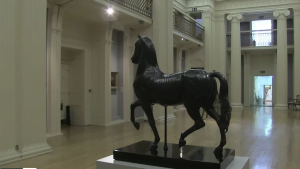
The Torrie Collection takes its name from Sir James Erskine, 3rd Baronet of Torrie, who bequeathed the remarkable works he had acquired to the University in 1836. Containing some of the finest Dutch painting and Renaissance sculpture in Scotland, the exhibition will include some exceptional artworks. Ruisdael’s Banks of a River is arguably the most important early painting by the artist anywhere in the world; de Vries’ Cain and Abel a unique piece for British collections; and the Anatomical Figure of a Horse is a stunning insight into the quest of Renaissance artists to develop the understanding of anatomy.

The Collection represents the Grand Tour tradition of collecting and the democratic principle of gifting art to the Nation, part of the great nineteenth-century expansion of both museums and universities across Britain. The terms of the Torrie gift stipulated that these works of art be made available to the general public for the express purpose of, “laying the foundation of a gallery for the encouragement of the Fine Arts.”Also a founding collection for the National Gallery of Scotland when it opened in 1859, its story is an integral part of Scotland’s national heritage.

Ongoing from 29 October, Talbot Rice Gallery, Edinburgh

Monica de Bath : PLOT/CEAPACH

An artists’ residency at a Bord na Móna peat excavation site at Ballydermot Works, Co. Kildare opened up conversations and interactions with staff and led to Monica’s ongoing, evolving arts practice investigating tensions between making a living and ecological land use.

This exhibition explores the changing nature of land use, biofuels, restoration and renewable energy projects on the Bog of Allen and Atlantic Bog in Ireland. monicadebath.wixsite.com/monicadebath

A series of related workshops will also be facilitated by Monica de Bath.

Dunamaise will host a related seminar Sites of Tension / Sites of Collaboration on Sat 19 Nov.

Exhibition runs 22 October – 27 November, Dunamaise Arts Centre, Portlaoise, Co. Laois, Ireland

Exhibition reception on Saturday, 19th November, 5pm

Gemma Gallagher, Evelyn Kelly and Linda McGee : Utopia

An ensemble of performers with intellectual disability from St Christopher’s Services, Longford and the Visual Theatre Programme, Mermaid will devise a theatre piece with Gemma Gallagher (Shadowbox Theatre). Gemma, will guide and direct this ensemble of actors to create from the heart of the participants own reflections and experiences finding imaginative ways of sharing their story and challenging preconceptions of what it is to be ‘other’. This piece will be performed in Longford and Bray, as part of a collaboration between Backstage and Mermaid.

Supported by the Arts Council, Co Longford Arts Office and the Ireland Funds.

Backstage Theatre in association with the Mermaid Arts Centre

Tue 15 Nov 2016, Mermaid Arts Centre
Fri 18 & Sat 19 Nov 2016, Backstage Theatre

Devin Karambelas : Context is Half the Work. A Partial History of the APG

4 August – 31st October
Lower Church Gallery, Summerhall

A profile of the exhibition as realised at Summerhall researched and presented by Devin Karambelas.

This APG exhibition was curated by Naomi Hennig and Ulrike Jordan in dialogue with Barbara Steveni. Artists involved include Ian Breakwell, Roger Coward, Garth Evans, David Hall, John Latham, George Levantis and Barbara Steveni and others.

The Artist Placement Group (APG) was founded in the UK in 1966. The group initiated and organised placements for artists within industry and public institutions where they would research, develop ideas and projects in-situ. According to the APG principle, artistic practices and knowledge no longer needed to be confined to the studio, but the reach of the artist could extend to commercial, industrial and government contexts in order to contribute to social and organisational processes at all levels.

Context is Half the Work. A Partial History of the Artist Placement Group explores seven paradigmatic APG placements; it includes research material, video works, art works and documentation of the group’s activity, raising questions still relevant for present day context-based artistic practices. These include sculptor Garth Evans’ two-year fellowship at the British Steel Corporation (1969-70), David Hall’s TV Interruptions, broadcast on Scottish Television in 1971, George Levantis’ journeys on the container cargo ships of Ocean Fleets Ltd (1974-75), Roger Coward’s placement with the Department of the Environment (1975) where he worked with inhabitants of a Birmingham neighbourhood, and John Latham’s association with the Scottish Office (1975-76). Negotiations with the UK Department for Health and Social Security (DHSS) led to two placements for Ian Breakwell, and other artists associated with the APG. The first took place within a psychiatric hospital (1976) and the second was an interdisciplinary APG/DHSS research project which led to the development of an audio-visual therapy method for dementia-afflicted patients (1978-79). In addition, a selection of Barbara Steveni’s contextualizing video walks and interviews with women protagonists of the time will be shown.

The acclaimed exhibition curated by Naomi Hennig and Ulrike Jordan in dialogue with APG co-founder Barbara Steveni debuted at Kunstraum Kreuzberg/Bethanien, Berlin in 2015 (12 September – 8 November). The second iteration of the exhibition staged at Summerhall is the first Scottish exhibition giving an overview of this seminal group and related works, and is reworked in order to highlight the APG projects that took place in Scotland.Curated by Naomi Hennig and Ulrike Jordan in dialogue with Barbara Steveni. Artists include Ian Breakwell, Roger Coward, Garth Evans, David Hall, John Latham, George Levantis and Barbara Steveni and others.

The Artist Placement Group (APG) was founded in the UK in 1966. The group initiated and organised placements for artists within industry and public institutions where they would research, develop ideas and projects in-situ. According to the APG principle, artistic practices and knowledge no longer needed to be confined to the studio, but the reach of the artist could extend to commercial, industrial and government contexts in order to contribute to social and organisational processes at all levels.

Context is Half the Work. A Partial History of the Artist Placement Group explores seven paradigmatic APG placements; it includes research material, video works, art works and documentation of the group’s activity, raising questions still relevant for present day context-based artistic practices. These include sculptor Garth Evans’ two-year fellowship at the British Steel Corporation (1969-70), David Hall’s TV Interruptions, broadcast on Scottish Television in 1971, George Levantis’ journeys on the container cargo ships of Ocean Fleets Ltd (1974-75), Roger Coward’s placement with the Department of the Environment (1975) where he worked with inhabitants of a Birmingham neighbourhood, and John Latham’s association with the Scottish Office (1975-76). Negotiations with the UK Department for Health and Social Security (DHSS) led to two placements for Ian Breakwell, and other artists associated with the APG. The first took place within a psychiatric hospital (1976) and the second was an interdisciplinary APG/DHSS research project which led to the development of an audio-visual therapy method for dementia-afflicted patients (1978-79). In addition, a selection of Barbara Steveni’s contextualising video walks and interviews with women protagonists of the time will be shown.

This exhibition debuted at Kunstraum Kreuzberg/Bethanien, Berlin in 2015 (12 September – 8 November). The second iteration of the exhibition staged at Summerhall is the first Scottish exhibition providing an overview of this seminal group and related works and was reworked to highlight the APG projects that took place in Scotland.

Paul Nesbitt : 30 years of exhibitions at Inverleith House

Inverleith House was designed in 1773 by David Henderson and built for Sir James Rocheid (1715-1787) as his family home and centre piece of his estate in 1774 at a total cost of £4,109. Around 1820 a part of the Inverleith estate was sold to become the Royal Botanic Garden Edinburgh (RBGE). The house was gifted to the Crown in 1877 together with the surrounding land for the purpose of extending the activities of RBGE and for the enjoyment of the public. After restoration work following a fire, Inverleith House became the official residence of the Regius Keeper (director) of RBGE. From 1960 it housed the new Scottish National Gallery of Modern Art, which in 1984 moved to the building of the former John Watson’s Institution in west Edinburgh. On 4 December 1970 the house was listed as a historic building. Since 1986 Inverleith House has been used as an exhibition space by RBGE.

Inverleith House is currently closed to the public.

Paul Gaffney : Perigee

Exhibition dates: October 12 to November 18 2016

Artist’s Talk: Paul Gaffney will give a public talk about the making of the work on November 16 at 5pm. Admission is free, all welcome, book here

For the past number of years, Irish artist Paul Gaffney has been investigating different ways of experiencing and representing landscape. This exhibition features two recent bodies of work, which have been photographed entirely by the light of the moon.

Perigee refers to the point in the moon’s orbit at which it is closest to Earth. Walking through forest landscapes by daylight, Gaffney documented his wanderings using polaroids. Later, he re-explored some routes after nightfall, to photograph under the light of the full moon. Bathed in its soft otherworldly glow, the forest’s narrow steep valleys evoke a mysterious, psychological wilderness in what is, in reality, a highly managed man-made environment.

A related body of work, Stray, was photographed in a dense pine forest in almost total darkness in late 2014, and is exhibited here using multiple slide projectors. The dark immersive installation evokes an experience of being at the edge of one’s comfort zone and cautiously moving through a disorientating and constantly changing environment, where our visual sense is so limited that our other senses become extremely heightened.

Drawn with light that is barely perceptible to the eye, Gaffney’s photographs emerge out of intuition, coincidence, and an underlying longing for connection and stillness. And although it’s tempting to call them landscapes, they are created through different ways of knowing a place – ways that acknowledge the moving, feeling body, rather than the distanced and distancing eye, as the foundation of our experience. – Eugenie Shinkle, January 2016

David McGinn : Black Church Print Studio

Black Church Print Studio is an artistic collective and one of the leading contemporary fine art print studios in Ireland.

Established in 1982, Black Church Print Studio provides fully equipped facilities for all types of fine art printmaking from traditional to innovative techniques. Approximately two-hundred artists use the workshop yearly through our various access programmes and courses/workshops. Full-time technical and administrative support is available from Mondays through Fridays from 10am–5pm. Visitors are welcome by appointment.

Black Church Print Studio is a non-profit organisation grant-aided by the Arts Council and Dublin City Council.

Friends Print Draw 2016
The Library Project, 4 Temple Bar, Dublin 2
18 November 2016
Viewing from 6pm | The Draw kicks-off 7pm sharp!

Vanessa Donoso Lòpez : To Swallow a Ball

In her practice, Vanessa Donoso Lòpez explores the forces of contemporary migration. As part of our ongoing Art & Ecology programme, a partnership between Dublin City Council Arts Office and our colleagues in Parks and Biodiversity, we invited Vanessa to consider the importance of soil. Her research included visits to Bull Island, part of the UNESCO Biosphere in Dublin bay.

As a resident of Dublin for over a decade, born in Barcelona, Vanessa’s work relates migration to ideas of transitional phenomena, language, crossed cultural identity, adult homesickness and compatibility between cultures. We are delighted to have Martí Manen, Stockholm based Spanish curator and art critic to write about the work.

In an age of rapid growth of global interconnectivity, individual identification, attachment to place, political and sociocultural ways of being are continuously affected. In the process of change and movement, a sense of belonging becomes more relevant to us as individuals and as citizens of the world. Vanessa has been mining the ground beneath her feet in both Ireland and Spain for clay as a material for this exhibition creating a very particular relationship with place. At each place, including the park beside the LAB on Foley Street, the process of digging and making has led to discussions with people surprised by the possibilities of clay. This exploration of our relationship to soil, clay and our earliest forms of written communication is a work still in progress for the artist. During the exhibition a series of events will provide opportunities for audiences to discover the processes involved in making clay with the artist and learn more about soil and composting with our biodiversity team.

In this time of immense change in our world, To Swallow a Ball presents different methodologies as coping strategies and a means to aid comprehension and facilitate communication, while reconnecting with the earth beneath our feet.

9 September to 10 November, The LAB Gallery, Dublin

Stephen Lau and Sadbh O’Brien : GUM

Gum is a collective of Dublin based visual artists, established in 2013. Originating from printmaking, our members and skill set have evolved beyond print into sculpture, assemblage, video, performance, animation and paint, whilst maintaining the community ethos and sensibilities associated with printmaking.

We have created an environment of analytical discussion and open debate about visual art and one another’s practice. Through the sharing of ideas, methodologies and materials our work has diversified and developed, while maintaining distinctive qualities individual to each member.

Upon graduating, the members of GUM have set about developing a collective space as a dynamic environment for making art and generating conversations, founded upon a strong sense of community and approachability. Striving to increase accessibility and engagement in the Visual Arts through our continued participation in the Irish and International art scene, we strive to establish relationships with other practitioners, collectives and audiences. Through this we endeavour to create an extensive and diverse network.

Our constant aim is to produce exciting and engaging art for both ourselves and the viewer. We hope to promote printmaking as a diverse practice, a traditional medium that we try to revitalise and reinvent. Through our innovative collaborative projects and a series of exhibitions coupled with our fresh approach to social media we hope to engage with a broader audience. This will hopefully promote a discourse in this space refocusing the position between artist and audience.

Artists: Aaron Burns, Aaron Smyth, Alex de Roeck, Aimee Gallagher, Ciara O’Brien, Ciaran Gallen, Clare Marie Ryan, Eoin O’Reilly, Luke O’Meara, Sadbh O’Brien, Sofia Mikhaylova and Stephen Lau.

Jane Locke : Tales from a Green Post Box

Jane Locke is an artist whose work fuses historical and scientific facts with almost imperceptible fictions – encouraging the audience to look, and look again.

Jane Locke was educated at the Dun Laoghaire College of Art, Design and Technology and received a BA in Visual Arts Practice (First Class Honours) in 2007. In 2014 she received a Masters in Fine Art from NCAD. She also holds a BSc in Analytical Science from Dublin City University and has over ten years experience working in the pharmaceutical industry.

Exhibition on until 9th November, The LAB gallery, Dublin

Ballet Ireland : The Nutcracker

Ballet Ireland will be touring The Nutcracker kicking off at:-

Roscommon Arts Centre: Saturday 5 November
An Grianán Theatre, Letterkenny: Saturday 6 November
Riverside Theatre, Coleraine: Tuesday 8 November
The Theatre at the Mill, Newtownabbey: Wednesday 9 November
The Burnavon, Cookstown: Friday 11 November
The Ardhowen Theatre, Enniskillen: Saturday 12 November
Gaiety Theatre, Dublin: Wed 16 – Sat 19 November
Garage Theatre, Monaghan: Tuesday 22 November
Hawk’s Well Theatre, Sligo: Wednesday 23 November
Draíocht, Blanchardstown: Friday 25 November
Everyman Theatre, Cork: Saturday 26 November
Town Hall Theatre Galway: Tues 29 & Wed 30 November
Civic Theatre, Tallaght: Thurs 1 – Sat 3 December
Dunamaise Arts Centre, Portlaoise: Mon 5 & Tues 6 December
The Helix, Glasnevin, Dublin 9: Thursday 8 December
Lime Tree Theatre, Limerick: Fri 9 & Sat 10 December
Siamsa Tíre, Tralee: Sunday 11 December
Solstice Arts Centre, Navan: Tuesday 13 December
Backstage Theatre, Longford: Wednesday 14 December
glór, Ennis: Friday 16 December
Watergate Theatre, Kilkenny: Saturday 17 December
The Source Arts Centre, Thurles: Sunday 18 December
Dean Crowe Theatre: Tuesday 20 December
VISUAL, Carlow: Wednesday 21 December
Mermaid Arts Centre: Thurs 22 & Fri 23 December

For further details: balletireland.ie

Devin Karambelas : Context is Half the Work. A Partial History of the APG

4 August – 31st October
Lower Church Gallery, Summerhall

A profile of the exhibition as realised at Summerhall researched and presented by Devin Karambelas.

This APG exhibition was curated by Naomi Hennig and Ulrike Jordan in dialogue with Barbara Steveni. Artists involved include Ian Breakwell, Roger Coward, Garth Evans, David Hall, John Latham, George Levantis and Barbara Steveni and others.

The Artist Placement Group (APG) was founded in the UK in 1966. The group initiated and organised placements for artists within industry and public institutions where they would research, develop ideas and projects in-situ. According to the APG principle, artistic practices and knowledge no longer needed to be confined to the studio, but the reach of the artist could extend to commercial, industrial and government contexts in order to contribute to social and organisational processes at all levels.

Context is Half the Work. A Partial History of the Artist Placement Group explores seven paradigmatic APG placements; it includes research material, video works, art works and documentation of the group’s activity, raising questions still relevant for present day context-based artistic practices. These include sculptor Garth Evans’ two-year fellowship at the British Steel Corporation (1969-70), David Hall’s TV Interruptions, broadcast on Scottish Television in 1971, George Levantis’ journeys on the container cargo ships of Ocean Fleets Ltd (1974-75), Roger Coward’s placement with the Department of the Environment (1975) where he worked with inhabitants of a Birmingham neighbourhood, and John Latham’s association with the Scottish Office (1975-76). Negotiations with the UK Department for Health and Social Security (DHSS) led to two placements for Ian Breakwell, and other artists associated with the APG. The first took place within a psychiatric hospital (1976) and the second was an interdisciplinary APG/DHSS research project which led to the development of an audio-visual therapy method for dementia-afflicted patients (1978-79). In addition, a selection of Barbara Steveni’s contextualizing video walks and interviews with women protagonists of the time will be shown.

The acclaimed exhibition curated by Naomi Hennig and Ulrike Jordan in dialogue with APG co-founder Barbara Steveni debuted at Kunstraum Kreuzberg/Bethanien, Berlin in 2015 (12 September – 8 November). The second iteration of the exhibition staged at Summerhall is the first Scottish exhibition giving an overview of this seminal group and related works, and is reworked in order to highlight the APG projects that took place in Scotland.Curated by Naomi Hennig and Ulrike Jordan in dialogue with Barbara Steveni. Artists include Ian Breakwell, Roger Coward, Garth Evans, David Hall, John Latham, George Levantis and Barbara Steveni and others.

The Artist Placement Group (APG) was founded in the UK in 1966. The group initiated and organised placements for artists within industry and public institutions where they would research, develop ideas and projects in-situ. According to the APG principle, artistic practices and knowledge no longer needed to be confined to the studio, but the reach of the artist could extend to commercial, industrial and government contexts in order to contribute to social and organisational processes at all levels.

Context is Half the Work. A Partial History of the Artist Placement Group explores seven paradigmatic APG placements; it includes research material, video works, art works and documentation of the group’s activity, raising questions still relevant for present day context-based artistic practices. These include sculptor Garth Evans’ two-year fellowship at the British Steel Corporation (1969-70), David Hall’s TV Interruptions, broadcast on Scottish Television in 1971, George Levantis’ journeys on the container cargo ships of Ocean Fleets Ltd (1974-75), Roger Coward’s placement with the Department of the Environment (1975) where he worked with inhabitants of a Birmingham neighbourhood, and John Latham’s association with the Scottish Office (1975-76). Negotiations with the UK Department for Health and Social Security (DHSS) led to two placements for Ian Breakwell, and other artists associated with the APG. The first took place within a psychiatric hospital (1976) and the second was an interdisciplinary APG/DHSS research project which led to the development of an audio-visual therapy method for dementia-afflicted patients (1978-79). In addition, a selection of Barbara Steveni’s contextualising video walks and interviews with women protagonists of the time will be shown.

This exhibition debuted at Kunstraum Kreuzberg/Bethanien, Berlin in 2015 (12 September – 8 November). The second iteration of the exhibition staged at Summerhall is the first Scottish exhibition providing an overview of this seminal group and related works and was reworked to highlight the APG projects that took place in Scotland.

Conor Rush : Viewport

New work by 20ten and guests revealing broad vistas which may be partially obscured. A restricted outlook that re-focuses our experience of the world.

20ten collective are delighted to announce the opening of Viewport. This collection of new work at Studio 20ten is part of Imagine Festival.

Through ‘Viewports’ we may encounter a variety of perspectives that offer different ‘windows’ on the same subject. The work includes photography and prints, paintings and sculpture in a range of media, and installation artwork.

‘Viewport’ reveals vistas and looks into limited aspects of reality. It doesn’t necessarily reflect the truth of the wider world. Windows, doorways, frames and optical devices are points of entry into different domains, while digital technology also exposes us to new realms.

The exhibition runs from 12th October to 19th November.
Studio 20ten, Waterford City

Derek Egan : The Plough and the Stars

Set amid the tumult of the Easter Rising, The Plough and the Stars is the story of ordinary lives ripped apart by the idealism of the time.
The residents of a Dublin tenement shelter from the violence that sweeps through the city’s streets. A revolution that will shape the country’s future rages around them. What kind of Ireland awaits them? When The Plough and the Stars was first performed at the Abbey Theatre in 1926 the audience rioted. Now regarded as a masterpiece, Sean O’Casey’s provocative play is an essential part of our understanding of 1916.

By kind permission of Samuel French.

Thurs 27th – Sat 29th Oct, VISUAL, Carlow

Aedín McGinn : Lullaby

Luan Gallery is delighted to announce its autumn exhibition entitled Lullaby which will feature the work of celebrated Mullingar artist, Patrick Graham. The exhibition includes some new and previously unseen works by Graham. Graham’s natural gift for drawing was spotted and nurtured by a sympathetic art teacher; Diarmuid Larkin, who mentored the young artist helping him secure a scholarship to the National College of Art where he studied from 1959-1963.
Patrick Graham has had significant influence on the Irish art scene and is credited by some as changing the face of Irish art in the 1980s with his introduction to neo-expressionism. A member of Aosdána, Graham’s exquisite craftsmanship and expressive layering of images and text have seen him widely regarded as one of Ireland’s most important contemporary artist.

20th August – 28th October 2016, Luan Gallery, Grace Rd,
Athlone, Co. Westmeath

Steve Maher : Calling Athlone

Calling Athlone is a relational installation and broadcast based art project which makes use of Athlone’s deep historic connection to broadcasting both past and present. Collaborators on the project led by artist Steve Maher include the Marconi Heritage Group and Athlone Community Radio.

The project will connect communities within Athlone to their rich broadcasting heritage and the empowerment that broadcasting can offer. The project aims to make these connections through an exploration of the technology and sites linked to the history of broadcasting in the area.

Calling Athlone will work with a variety of participants who, following a tour of the Moydrum transmitter site, will participate in workshops. The workshops will lead to the production of home-made crystal set radios and broadcast material for a short radio documentary. The radios will be on display in Luan Gallery for the month of October and the documentary will be broadcast through them.

11th October – 31st October 2016, Luan Gallery, Athlone, Co. Westmeath

Maria O’Brien : Hallways of Hope

‘Hallways of Hope’ is an exhibition inspired by a cross curricular project in the Midlands Prison Education Centre. This project aims to reach as many prisoners as possible in order to promote positivity, hope and mental health awareness. The resulting artworks emerged from the question ‘What does hope mean to me?’. The pieces are displayed on the walls of the prison and in the Education Centre. The making of art is an inherently healthy and valuable thing to do. Being involved in a group project such as this is a way to avoid isolation and to reach out to a wider community.

The art and craft works in themselves were intended to raise awareness of mental health issues and inspire hope. The theme of hope was broadly interpreted and as a result we have a diverse range of art works including mosaics, pottery, paintings, drawings and glass. The project is on-going and this exhibition represents a selection of the range of work produced by the participants.

Exhibition runs 16 September -15 October, Dunamaise Arts Centre, Church Street Portlaoise, Co. Laois, Ireland.

Michael Dempsey: … Modality of the Visible

The Hugh Lane is pleased to present this exhibition of paintings and prints by Michael Kane, 19 October 2016 – 15 January 2017.
The exhibition will be accompanied by an illustrated catalogue with essays by Michael Dempsey, Elizabeth Hatz and Róisín Kennedy.
19 October 2016 – 15 January 2017

Paul Gregg : Inductive Probability

Inductive Probability at the RHA in Dublin is a namesake exhibition that follows a retrospective of work by Paul Gregg held at the Triskel Arts Centre, Cork in 2012. Gregg’s work has occurred fleetingly, and been installed permanently in cities and towns throughout Ireland, Europe and the United States. This exhibition for the most part cannot retrieve the artist’s original installations. So instead, it presents a selection of available sculpture work along with a substantial new object titled Mens sana in corpore sano. The art on display covers twenty years’ worth of perennially sited machines.

Leading up to the 2012 retrospective, Oliver Dowling wrote:
“Paul Gregg is always an exciting presence and having known his work for many years it will be very exciting to see it all together. It will make for a very dynamic exhibition. He is an artist whose quiet demeanor defies a creative energy that at times is literally explosive. From his earliest work there is an element of surprise that can, at first, confuse but always ends up exciting and even humorous. In addition to being an artist, he is a scientist, inventor, maker and creator. This is truly an exhibition to look forward to”.

From September 09, 2016 to October 23, 2016

Nathalie Weadick : Open House Dublin 2016

This is the 11th edition of Open House Dublin (OHD) and doesn’t time fly. Since its inception, Open House Dublin has proved its potential to engage with a wide range of our city’s shapers – from general public to policy-makers – highlighting the significant role that architecture can, and has, played in the evolving form of our everyday lives. Our intention is to build upon the festival’s annual celebration of the county’s best architecture and to inspire a better understanding of the processes and places that define us.

Open House Dublin 2016 will focus on the theme of time, commemoration and celebration, titled The Presence of the Past. The past is full of possibility when we use it to help us make informed decisions about the future. The Presence of the Past connects time to buildings and uncovers how they reflect our priorities culturally, socially, economically and politically.

Through an extensive programme of talks, tours and exhibitions, it is our goal to highlight the buildings of Dublin that have altered our vision of the city over time, shaped how we live now inspire new ways of living.

I would like to thank our OHD project funders, Dublin City Council, Government Policy on Architecture 2009-2015 and Airbnb, with additional funding from Dún Laoghaire-Rathdown County Council and Hibernia Reit. I am grateful to our in-kind supporters JCDecaux, Totally Dublin, Dublin Bus and RTÉ Supporting the Arts. I would also like to acknowledge the IAF funders; the Arts Council, the Department of Arts, Heritage, Regional, Rural and Gaeltacht Affairs, the Office of Public Works and the IAF members.

Open House Dublin can’t keep opening up doors for free without your help. I ask you kindly to consider supporting the work of the Open House Dublin through partnership opportunities available on our website. Finally, a big thank you to the building owners, the guides, the fabulous OHD army of volunteers and the IAF OHD delivery team. We are indebted to your hard work and avid passion for your built environment.

FROM 14—16 OCTOBER 2016. For further details… openhousedublin.com/

Andrew Edgar, Kate McElroy and Eimhin McNamara : A4 Sounds

A4 Sounds is a interdisciplinary arts organisation based in Dublin but with members dotted across the globe. You will find us in Ireland, U.K, Canada, Hong Kong, Japan, Australia and The Philippines.

The mission of the A4 Sounds arts organisation is to foster interdisciplinary collaboration both nationally and internationally, to add to the field of socially engaged art through our projects and actions, and to be recognised as a worthy addition to the field. We want to make art that matters.

Our workspace is an extension of this work, intended as a participative socially engaged arts and education centre in Dublin. Drawing on the best elements from existing artist studios, maker spaces, social spaces and education practices both nationally and internationally, we are developing a unique model which both supports practitioners’ professional development and effects real social change in response to our needs as citizens and communities, and how we access and participate in arts and education.