Rachel McIntyre : Verne Dawson at Douglas Hyde

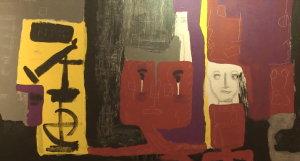
Verne Dawson’s paintings typically display a preoccupation with history, collective memory and the measurement of time; he is fascinated by the attempts humanity has made to comprehend the mystery of our place on earth and to pass on inherited understanding to later generations. A deep interest in prehistoric art, ritual, fairytales and superstition makes its way into his work, which is often influenced by the mathematical and astronomical grounding of folklore, calendars and astrology.

The small group of paintings in Gallery 2 reveals a different facet of Verne Dawson’s style. Selected by the artist in relation to the work of Bill Lynch, whose Gallery 1 exhibition he curated, the five pictures are more obviously figurative and gestural than usual, while remaining just as mysterious and enigmatic as his more familiar narrative landscapes. They include an early portrait of Lynch.

Verne Dawson’s ‘432’ took place in 2004 in Gallery 1 at the Douglas Hyde Gallery. His work was also represented in the group exhibition ‘Huts’ later that year, and in 2008 he showed in Gallery 2, in the ‘Paradise’ series. He has exhibited widely around the world, most recently in solo exhibitions at Eva Presenhuber, Zürich, Victoria Miro, London, and Gavin Brown’s enterprise, New York.

Rachel McIntyre : Bill Lynch at Douglas Hyde

Bill Lynch painted with oils directly onto plywood, the deft and often light marks belying the extensive deliberation afforded to his subjects. ‘He cared so much’, writes Michael Wilde in the publication accompanying this exhibition. He, like Verne Dawson, enjoyed a close friendship with Lynch for many years. Thanks to their enduring care and support, these intriguing paintings are being shown in Ireland for the first time.

In some of his works the picture plane is alive and dense with activity. Others make wonderful use of empty space, the untreated surface becoming integral to the composition. In one instance, the wood forms a tabletop on which ceramics appear precariously positioned. His quickly worked depictions of spider webs and reflections of tree branches in water celebrate the fragility and transience of nature and show his fondness for traditional Chinese and Japanese painting.

A prolific and consistent painter, Lynch rarely dated his works and often reworked old pieces by scraping back the surface with a blade. Surprisingly, for someone with such deep feeling for the history of painting, conservation seems to have been of little concern. The act of painting was instead a search for peace and freedom, as well as for a language to communicate with objects and creatures in the world around him.

Bill Lynch (1960 – 2013) was born in New Mexico and grew up in New Jersey. He studied art at Cooper Union in the late 1970s and lived in New York for many years, as well as in California and North Carolina. His first solo show was at White Columns, New York in 2014. Later that year, his work was shown at The Approach, London, and in 2015 it was exhibited at Tanya Leighton Gallery, Berlin.

The Douglas Hyde Gallery expresses warm gratitude to Verne Dawson, who curated this exhibition and has done so much to make it possible, and to Michael Wilde, whose text and correspondence with Lynch throw much light on a complex and impassioned artist. We also thank Gerry Lynch; White Columns, New York; The Approach, London; and all of the lenders.

Lisa Fox & Bill Murphy: Once the Musical

Once, the multi-award-winning Irish musical drama, returns to the Olympia Theatre, Dublin from 2 July – 27 August, 2016. Once is full of glorious music and authentic Irish charm. With songs including the Oscar-winning Falling Slowly, this funny, moving and life-affirming love story has captured hearts around the world.
Based on the movie sensation of the same name, filmed and set in Dublin, the show tells the life-changing love story of ‘Guy’ and ‘Girl’, two musicians – he’s Irish, she’s Czech – who meet by chance on a Dublin street and create something wonderful together. Once features music and lyrics by Glen Hansard and Markéta Irglová and a Tony award-winning book by Enda Walsh.

Anna Moore : No Zebra Crossing

No Zebra Crossing an exhibition by Co Waterford artist, Anna Moore. The large scale acrylic paintings are an emotional response to over three years the artist spent working with the San of Namibia, (previously known as ‘Bush men’). The deep respect that the San have for the land taught Anna to experience the Kalahari desert on many different levels. The large paintings reflect the colour and vastness of the Namibian desert landscape. One painting is twelve feet long, another stretches to twenty four feet. They are also a response to the effects of colonisation, exploitation and overgrazing of the land. This highlights the further marginalisation the San people. Yet in spite of almost complete destruction of their traditional hunter-gatherer lifestyle, the San people have never lost their love and respect for the land and their culture. This has inspired her work.

Date: Wednesday 13 April – Saturday 28 May 2016

Venue: Garter Lane Arts Centre, O’Connell Street, Waterford 051) 855 038
garterlane.ie

Pat Kinevane : Silent

Silent is the touching and challenging story of homeless McGoldrig, who once had splendid things. But he has lost it all – including his mind. He now dives into the wonderful wounds of his past through the romantic world of Rudolph Valentino.

7th May: Draíocht, Blanchardstown
14th May: Visual, Carlow
24th August: Town Hall Theatre, Galway
24th September: Nenagh Arts Centre

Catherine O’Riordan : Young II, SO Fine Art Editions

‘Following the success of our 2014 exhibition ‘Young’, SO Fine Art Editions is pleased to announce the next installment ‘Young II’. This multidisciplinary exhibition will feature printmaking, photography, painting, sculpture, bookmaking and applied arts by an exciting group of young visual artists emerging into Ireland’s ever diversifying art scene. These artists are the best on the scene in their particular mediums with many having received awards and recognition for their work. They are pushing boundaries, exploring fresh concepts and challenging perceptions in order to generate conversations and engage audiences.’

Artists include: Ailbhe Barrett, Magda Bethani, Cathy Burke, Aaron Burns, Cathy Cannon, Sophie Carroll-Hunt, Neil Dunne, James Earley, Melissa Ellis, Kevin Killen, Allan Kinsella, Stephen Lau, Richard Lawlor, Sabina MacMahon, Peter Martin, Jamie Murphy, Liam Murphy, Sasha McVey, Ciara O’Brien, Lesley-Ann O’Connell, David O’Kane, Etaoin O’Reilly, Eileen O’Sullivan, Yestin Reboul, Aoife Scott, Julie Scott, Aaron Smyth, Evelina Wojtowicz.

Sara Smyth : NLI’s Rising and Signatories exhibitions

Rising is a major photographic exhibition which showcases the National Library’s rich imagery of the events and locations of 1916.

Rising draws on some of the most important collections of photographs at the National Library. It includes images from the Keogh Collection, the Independent Newspapers (Ireland) Collection and newly digitised photographs from the De Valera Collection, and various 1916 albums. It consists of 60 photographs, including a number of large scale photographs which emphasise the Rising’s impact on Dublin’s city centre. These images are enhanced by audio recordings of actors reading from selected letters and diaries detailing first-hand accounts of the Rising.

Who were the men and women affected by the Rising? How did Dublin look during Easter Week 1916, as fighting raged and buildings fell? What kind of landscape was left after the surrender?

See it all at the National Photographic Archive, Meeting House Square, Temple Bar, Dublin 2.

Rising is free to visit, and is open seven days weekly: Monday to Saturday 10am to 5pm and 12noon to 5pm on Sundays.

The exhibition runs in the National Photographic Archive until the end of October 2016.

Dawn Williams : 1916 Ireland in Contemporary Art

Commissioned by Larry Lambe, the exhibition will feature works by artists including: Alice Maher, Robert Ballagh, Rita Duffy, Michael Coady and David Lilburn.

Varying in scale and media, from painting to poetry, the only instruction the commissioned artists received from Lambe was that the work should be linked with any event of 1916 that affected Ireland, including the Easter Rising.

The commissioning process started in 2009 in order to allow the artist time to have a mature look and consider the commission over a generous time-span. The artists have also been invited to write in relation to their created work, which will be hung alongside each work offering the viewer an added layer of context and mediation. – See more at:crawfordartgallery.ie/1916_Ireland_Contemporary_Age.html#sthash.F2dqfwgQ.dpuf

Sheena Barrett, Liz Burns, Pádraig Naughton, Suzanne Walsh & Aideen Barry : A Different Republic

A Different Republic (Nov 2016 – Jan 2017)

A visual arts exhibition rooted and centered on the theme of ‘Equality’ for presentation in 2016, this exhibition will be a complex consideration of the notion of Republic, where ideas of difference and equality are fore-grounded, drawing on the Proclamation of the Irish Republic (1916) and the Universal Declaration of Human Rights (1948). The exhibition will feature a number of Internationally acclaimed Irish artists with disabilities. The exhibition is a partnership between Arts & Disability Ireland, Fire Station Artists’ Studios and the LAB (Dublin City Council Gallery – Foley Street)

Margaret Stafford : JestFest 2016

JestFest returns this May Bank Holiday Weekend – Wexford’s Comedy and Street Theatre Festival is back in 2016, bigger and better than ever! This May Bank Holiday weekend the spirit of devilish revelry fills the Viking streets as Irish and international street jesters, acrobats and contortionists wow us with their amazing shows. As the sun sets, the finest Irish stand-up comedians take to the stage in atmospheric venues all over town armed with hilarious one liners, anecdotes and monologues to make you laugh and make you cry.

The stellar line-up contains Irish comedy stars such as Neil Delamere, Jason Byrne, Deirdre O’Kane, Al Porter, Colin Murphy, Joe Rooney and Barry Murphy of Aprés Match fame, alongside international stars such as Canadian funnyman Tom Stade and fresh from selling out 3 Vicar Street shows, new sensations Foil Arms & Hog.
This year’s Festival sees the launch of the Comedy HUB, a state of the art 500 seat venue specially constructed on the Wexford Quay front. This venue will be a unique experience for the audience during the weekend, and will see the best comedians take to the stage each night. Comedy gigs will also take place a number of venues across Wexford town including the beautiful surrounds of the Greenacres Art Gallery, Upstairs in Mackens and the Talbot Hotel. The Quay will also be the location for a Street Theatre Arena, where the best of local, national and international talent will perform daily. Wexford’s finest Bui Bolg will be joined by amongst others, the Fanzini Brothers.

Malcolm McClay : Swimming to Inishkeel

CIT Wandesford Quay Gallery presents ‘Swimming to Inishkeel by Malcolm McClay.
Inishkeel Island is a small uninhabited Island off the west cost of Donegal, accessible by foot at low tide. In the Celtic tradition “a thin place” is the name given to a place where the visible and invisible worlds touch or are at their closest, a space where the veil between the temporal and celestial worlds has grown thin. For McClay Inishkeel is such a place.

9 to 30 April 2016, CIT Wandesford Quay Gallery, Clarke’s Bridge, Cork

Nollaig Molloy : Material Witness, Roscommon Arts Centre

Material Witness is an exhibition of new works by Nollaig Molloy. Using the National Schools Folklore Collection from 1937-38 as a point of departure, Nollaig examines the many stories, material culture and folk customs of County Roscommon, as told by the generation after the 1916 Rising.

The exhibition focuses on the materials-to-hand referred to within this collection of manuscripts. A particular story titled ‘The vessels used in olden times’ lists materials of wood, tin and clay used to make containers for specific everyday use. The exhibition is informed by an engagment with members of the South Roscommon Singers Circle and the community where these materials were resourced and will present a number of outcomes responding to small scale objects made on a production of necessity, to large scale industries supplying the whole country as described in the Folklore Collection.

Robbie Blake & Sorcha Coller : Insight

Smock Alley Theatre plays host to four evenings of the aural and the visual, brought together.
From March to July, InSight showcases 20 new musical works presented with visual interpretations, including dance, animation, projection, and simply the physical body in space.
Brought to you by the Irish Composers’ Collective, Tonnta Music and Smock Alley Theatre.
Grant aid from Arts Council Ireland and Dublin City Council.

Rhona Byrne and Yvonne McGuinness : Mobile Monuments

Artists Rhona Byrne and Yvonne McGuinness have worked in collaboration with a number of local senior and junior school groups to create Mobile Monuments which will begin travelling to Swords, Rush, Garristown and Castaheany during the month of April in advance of Fingal’s flagship Commemorative Day on April 24th in Swords Castle.

The Mobile Monuments are a series of sculptures built on 3 rickshaw tricycles that have the capacity to fold out and transform into colourful sites for performance and gathering when they arrive at their destinations. The artists and the groups have created props, banners, costumes and performances which have been inspired by the theme and activities associated with the 1916. The Monuments will begin their journey’s weekly in April.

Gallery of Photography : Reflecting 1916

Reflecting 1916 features photographs taken by eyewitnesses to this pivotal period in Ireland’s history, a number of which are being shown in public for the first time.

A centrepiece installation of large-scale photos captures the destruction of Dublin and offers viewers a dramatic, immersive experience. This is contextualised by explorations of the use of photography to represent the idealism and growing militarism of the revolutionary generation. The wider use of photography as a vital tool for propaganda focusses on Roger Casement and his use of photography to highlight crimes against humanity. Casement’s own documentary photographs from the Putamayo offer an insight into his evolution from British imperialist to Irish revolutionary. A further sequence includes images of the widows and orphans of the Rising that were reproduced in the Catholic Bulletin in 1916, highlighting how photography was used to sway public opinion in the immediate aftermath. The final section looks at how the Rising has been represented in subsequent commemorations. Accompanied by a catalogue with essays contributed by leading writers and historians, Reflecting 1916 is an exploration of the role played by photography in shaping our memory of the Easter Rising.

The exhibition draws from our rich photographic heritage held in national collections and private albums and includes photographs generously contributed by the Capuchins Ireland Archive; Dublin City Library and Archive; Irish Military Archives; Kilmainham Gaol; The National Library of Ireland /National Photographic Archive; The National Museum of Ireland; Peter McKee archive;Pearse Museum, St. Enda’s; RTÉ Archives; Royal College of Surgeons in Ireland; Trinity College Archives, UCD Archives and archival images on loan from John Osman.

Whitney McVeigh and Alice Thompson : In Conversation, International Women’s Day

Whitney McVeigh in conversation with Alice Thompson to discuss her exhibition Language of Memory and Alice’s new novel The Book Collector. The artist and writer address issues of motherhood and the parallel processes of writing and making.

March 8th, 2016 – International Women’s Day, Summerhall Arts

Anthea Hamilton : BAS8

Anthea Hamilton’s free-standing sculptures, which function as formicaries or ant farms, ants move within intricate Art Nouveau patterns over images drawn from the artist’s previous works: a woman acting as a human clapperboard and a figure clothed in full-dress Kabuki costume. The movement of the ants within these Perspex sculptures animates their otherwise static forms and is reminiscent of digestive, nervous and circulatory systems.

They performance devised by Hamilton in collaboration with dancer and choreographer Kostas Tsioukas took place at Inverleith House on Saturday 16 and Sunday 17 April.

For British Art Show 8 in Edinburgh Anthea Hamilton’s work is exhibited at Inverleith House, Royal Botanic Garden Edinburgh.

Peter Fulop : NOBU

Peter Fulop’s work in clay is heavily influenced by the Japanese Zen tradition. His experimentation with Raku reduction and wood firing techniques along with his use of calligraphic gesture is a culmination of experiences and time spent with traditional artists in China, Korea and Japan. In his most recent works Fulop pushes the boundaries of the traditional clay vessel seeking to exploit elemental processes of fired material intertwined with the artist’s gestural use of brushwork and glazing technique.

The body of the work is inspired by Takesada Matsutani’s solo show at the Hauser and Wirth Gallery, NY (2016), as well as Fulop’s teacher, Prof. Koie Ryoj, an avant-garde artist working in Japan. Both artists attempt to ‘come back to the moment’, in the creation of work inspired by the zen approach. Japanese in origin the title NOBU translates as ‘trust’ or ‘expend’ and refers to how the work emerges from a process of ‘conversation’ or ‘exchange of energy’ with the medium and how this ‘energy’, immanent to the work, is manifested or ‘expended’ in the viewers experience.

Sarah Pierce : Pathos of Distance

Pathos of Distance is formed around 42 images relating to Irish migration and diaspora, created between 1813 and 1912. Sourced from countries around the world, they have been photographed and reproduced to their original scale. Pierce presents them in a series of sculptures constructed from items of second-hand domestic furniture, culled from the stocks of suppliers in Dublin. In bringing these disparate images and objects together, these sculptures evoke the concept and rhetoric of diaspora, suggesting themes of displacement and hybridity.

Natasha Duffy & Maurane Ramone : Sonic Whispers

Sonic Whispers returns as part of MusicTown 2016 with a night of musical experimentation and collaboration!

On the 17th April at Whelan’s Live, Sonic Whispers will host three new bands from three diverse genres of music; Bitch Falcon (Rock), Wounded Healer (Electronic) and Bunoscionn (Trad) with an exciting host in the form of Rob Broderick of Abandoman, winner of the Adelaide Fringe 2012.

We’re ripping apart the history, ethos, and the sonic boom energy of three wildly diverse genres of music. We’re offering the chance to peer into the hearts and brains of the people behind the song-writing process, and offering YOU the unique chance to help to shape a song as part of a live improv experiment where everything is to play for and everyone gets to play.

How is music interpreted? How do we communicate through sound? How do musical genres influence us and how do they make us feel the way we do? This is what we want to find out!

Here’s how it works.

One band first. They play a tune. The next band is brought on stage. They’ve heard nothing so far. Then each band will try to reinterpret the song played by the previous band – the only catch is that since they’ll have their ears covered backstage, they will be relying on you to gives them clues and cues of how to play! What was the rhythm, can you remember the lyrics, how about the structure of the verse?!

Sonic Whispers will be a playful, insightful, and utterly unique evening that will explore both the idiosyncrasies of the genres, and the underlying harmonies of all musical expression.

ArtsIreland XIII

Thirteenth compilation of arts-news clips for the Arts Council’s culturefox.tv assembled for Belfast’s NvTv and Cork’s CCTV channels.

Jeda De Bri : Slice the Thief

“What do you do when you fall off the bike?” A huge slice on his stomach gave him his name. How’d it happen? He has no idea and today it’s the least of his worries.

Take what you want and it’s bound to catch up with you.

Slice: a funny, charming, everyday bike thief who does what he wants but today, he’s taken the wrong bike. 24 hours to get it back or he’s dead. The only problem is that the bike is now in the custody of an even bigger psycho than its rightful owner. The bike of his dreams leading to the day of nightmares. A whirlwind through the suburbs of Dublin at the speed of light. Beating the heart from your chest, where his past, present and future will all collide. Slice, the Thief. A dark comedy from the mind of Lee Coffey.

Emma-Lucy O’Brien : Recreating The Pastoral

Recreating The Pastoral draws the viewer through a series of installations which juxtapose elements of elaborate 18th and 19th Century European dress and courtly behaviour with contemporary political sensitivities expressed through Shonibare’s use of Dutch wax cotton cloth, itself a culturally ambiguous material replete with a colonial history of appropriation.The installations question Euro-centric histories, and are a powerful expression of the complexities inherent in contemporary discourse on post-colonialism and identity. Shonibare’s Jardin d’Amour mimics the frivolity and excess of 18th Century Europe. The theatrical staging of works, framed within an elaborate artificial maze draw references to the colonial relationship to landscape, and the control and creation of spaces for pleasure by a powerful elite.

David Rushton & Paul Robertson : Analytical Art, Art & Language and Thereafter

Lust in the Apple’s curator Paul Robertson in conversation with David Rushton.

Rushton was a founder editor of Coventry-based Analytical Art and was subsequently a key member of Art & Language from 1972 to 1975, working on the various Indexes for which the group became established, through exhibitions at Documenta 5 and the Hayward Gallery.

As a key agent in student-led activism throughout the 1970s, Rushton co-edited, contributed or printed several magazines and journals that reflected the decade-long adjustment to the reorganisation of UK art schools amid the insurgent artist-collective and self-organisation alternatives.

In 1979 he exhibited Motorshow at the New 57 Gallery in Edinburgh and at a Rally for the Socialist Workers Party in Edinburgh, focused on car industry working practices anticipating labour relations in British industry under Thatcher.

Motorshow was re-shown in 2014 at Talbot Rice in Edinburgh ahead of the Scottish independence
referendum. Also in the 1970s Rushton co-edited a special edition of Studio International, Politics of Art Education, and he coordinated tours, providing print-work and design for Rock against Racism and the Anti-Nazi League.

His work became an integral part of the wider counter culture of the 70s.

In the 1980s he began working with film through Red Star Cinema in Edinburgh and for national and local trades unions from Birmingham on representation and the conflicting issues of modernisation and marginalisation.

Returning to Edinburgh in the late 1980s he developed policy and promotion of local TV, publishing extensively on this topic. In 1995-96 he was instrumental in changing government broadcasting bill to favour the introduction of local TV.

He established two local TV channels in Scotland in 2000 and remains a director of a local terrestrial channel in Northern Ireland and runs several Internet arts-news channels in Scotland and Ireland (eg. artinscotland.tv, artinireland.tv)

In 2004 he exhibited with Terry Atkinson and David Bainbridge from Art & Language, all formerly with Art & Language and with whom he’d remained close since 1975.

The Atkinson, Bainbridge Rushton exhibition Reconstruction and Fabrication at the pop-up Model Art Gallery was held in 2004 as part of the first Edinburgh International Art Exhibition and later that year was shown at the University of Bath. He has subsequently exhibited in Berlin, Bath, Aberdeen, Coventry, Sanquhar, Bournemouth and Edinburgh.

His film, TV as well as policy archives are held by the National Library of Scotland while his art-work with Art & Language, Analytical Art, and individually can be found in public and private collections in the UK and abroad.

The Conceptual Art Museum from Memory was first exhibited at the Reconstruction and Fabrication exhibition in Edinburgh in 2004 and subsequently at Models and Metaphors, Concepts and Conceits in Coventry in 2010.

Work by Analytical Art and Art & Language is on display in Tate Britain’s Conceptual Art in Britain 1964–1979 which runs from 12 April – 29 August 2016.

Jock Mooney : Who are you and what do you want?

Date: 08 Apr 2016 – 25 Apr 2016 The Briggait 141 Bridgegate Glasgow G1 5HZ
Mooney constructs worlds populated by grotesque characters, strange animals, food, lurid flowers and morphed effigies of historical, mythical and religious figures. He likes to observe the various ways in which different cultures celebrate, memorialise and represent death. He strives to create works that refuse to be ignored, like an insistent child teamed with the beauty of something venomous.

In this show, he explores themes and symbolism pertaining to fertility, regeneration, economy, peace, health and prosperity.waspsstudios.org.uk

Andy Holden : Laws of Motion in a Cartoon Landscape (II)

Date: 08 Apr 2016 – 25 Apr 2016
Hanson Street Project Space, Wasps Studios, 77 Hanson Street Glasgow, G31 2HF
This exhibition is an attempt at a thesis for the world after the end of history, and in particular art history. How is the artist to proceed in a landscape after everything has already been done, where everything is seemingly equally possible?

This ever-evolving idiosyncratic theory will be adapted into a multi-screen film housed within its own immersive cartoon structure, supported by the surplus of works that were produced concurrently to the film’s evolution.

Supported by Glasgow International. waspsstudios.org.uk

Rosa Abbott : Richard Gorman – Iwano

Iwano is titled in recognition of Iwano Heizaburo, a master paper producer with whom Gorman worked closely until Iwano’s death earlier this year. Relying solely on traditional production techniques, the Iwano family has operated its paper factory in Echizen, western Japan, for ten generations. Iwano Heizaburo worked generously with the artist for more than 25 years to help produce his works on Echizen kozo washi paper, now a central – and celebrated – part of Gorman’s practice.

Iwano brings together a series of colourful paper diptychs, produced on an unprecedentedly large scale. Measuring 275 x 320 cm each, the works’ expanded size lends them a new monumentality, but also a delicacy and fragility; their format evoking emaki, the historic Japanese tradition of painting and calligraphy on scrolls. Each work from the series uses the same repeating geometric motif, playfully titled ‘Squeeze’, in an attuned but unexpected selection of colours, chosen, Gorman says, “not randomly, but intuitively”.

Gorman’s most ambitious body of work on paper so far, Iwano is the remarkable culmination of over two decades of collaboration with the Iwano paper factory. The exhibition also precedes an eventful summer for Gorman, who will mark his 70th birthday on 29 May with a major solo exhibition in Castletown House, Co Kildare.

Born in Dublin, Richard Gorman has lived and worked in Milan since the 1980s and has exhibited regularly for three decades. Major solo exhibitions include The MAC, Belfast (2014); Mitaka City Gallery of Art and Ashikaga City Museum of Art, Japan (2010); CCGA Koriyama Museum, Japan (2003); Royal Hibernian Academy, Dublin and Crawford Art Gallery, Cork (2001); Itami City Gallery of Art and Mitaka City Art Foundation in Japan (1999). Gorman is represented in many public and private collections worldwide, including the New York Public Library, Deutsche Bank, the Ulster Museum and the Josef and Anni Albers Foundation.